

Is changing the filters enough?
You have probably seen tutorials on YouTube or been told that maintaining your reverse osmosis system is as simple as “removing the old cartridges and putting in the new ones.” And yes, physically, changing a filter is easy. But maintaining the healthiness and efficiency of your system it’s a very different story.
In Sata Manteniments, we often encounter systems “maintained” by their owners that, despite having new filters, produce water of lower quality than tap water or suffer catastrophic breakdowns months later.
Why does this happen? Because changing the filters is only 10% of professional maintenance. Today we are going to explain the other 90%: the critical steps that most “Do It Yourself” guides ignore and that make the difference between drinking pure water or a “cocktail” of bacteria.
The invisible enemy: Sanitizing the tank
The number one mistake in home maintenance is ignoring the storage tank. Think about it: that tank stores stagnant water for hours. If you only change the pre-filters but don’t disinfect the tank, you are passing clean water through a dirty container.
Over time, on the walls of the tank forms Biofilm: a slimy layer of bacterial colonies resistant to chlorine and difficult to remove.
The Professional Protocol: A qualified technician not only changes filters. They perform a chemical sanitization following the UNE 149101 standard. The process we follow at Sata involves:
Completely empty the system.
Introduce a calculated dose of hydrogen peroxide (hydrogen water) or specific food-grade sanitizer into the system.
Let the chemical solution act for 15-20 minutes inside the tank to eliminate biofilm and any pathogens.
Perform controlled rinses (at least 5 emptyings) to ensure no chemical residues remain before you drink again.
Do you have the tools to measure the peroxide residue in the water before giving it to your family?
The physics of water: Expansion tank calibration
Your tank is not just a jug; inside it has an “air bladder” (expansion tank) that pushes the water toward the faucet. Over time, this air is lost.
If you change the filters but do not recalibrate this pressure:
- If the pressure is low: The faucet will release little water and the membrane will suffer back pressure, wearing out prematurely.
- If the pressure is high: The tank will not fill to its maximum capacity, wasting water.
The Technical Touch: During maintenance, it is mandatory to empty the tank and use a low-pressure gauge to verify that the air precharge is exactly between 0.3 and 0.5 bar (or 5-7 psi). If it is out of range, it must be repressurized with a specific pump. A vital step that almost no tutorial mentions.
The Silent Killer of Membranes: The Flow Restrictor
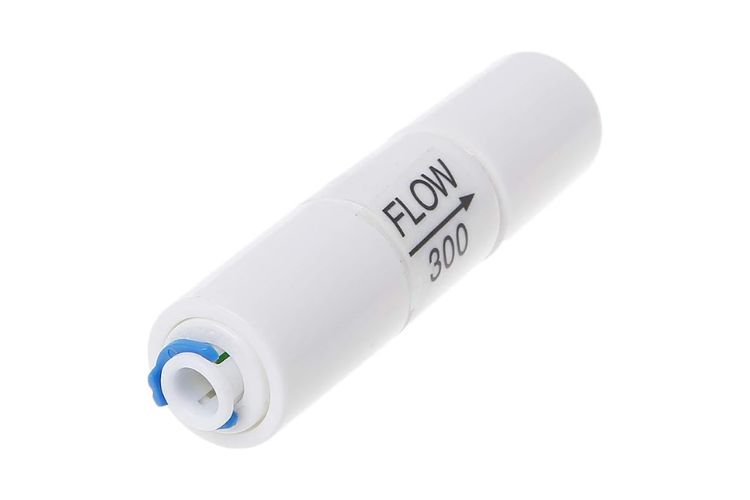
The reverse osmosis membrane is the heart of your system (and the most expensive part). For it to work, it needs a portion of the water to be discarded to the drain, carrying impurities. This is controlled by a small part called Flow Restrictor.
Over the years, this restrictor becomes clogged with lime. If you change the membrane but do not check or replace the restrictor:
- The reject water does not flow.
- All the lime and dirt stick to your new membrane.
- Result: Your new membrane gets punctured or saturated within weeks.
A professional always checks the reject flow (ml/min) to ensure that the ratio between pure water and discarded water is correct.
Tightness and safety: Better safe than sorry
Finally, there is the physical risk. Plastic tubes and O-rings dry out from chlorine and time. When moving the system to change the filters, it is very common to cause micro-cracks that do not leak immediately, but hours later, when you are no longer watching.
At Sata Manteniments, we check the integrity of all connections, apply food-grade silicone grease to the seals, and verify the 4-way valves and pressure sensors.
Your peace of mind is worth more than a filter
As you can see, maintaining a reverse osmosis system is a sanitary technical process, not a simple DIY task. The risk of doing it incorrectly ranges from ruining a €50 membrane by not changing a €3 restrictor, to exposing your family to bacteria by not sanitizing the tank.
In Sata Manteniments, our mission is to ensure the efficiency and durability of your system. For a reasonable price, you not only get new high-quality filters; you get the certainty that your water is chemically safe, that your system is calibrated, and that you won’t find your kitchen flooded tomorrow.
Time for a check-up? Don’t take chances.